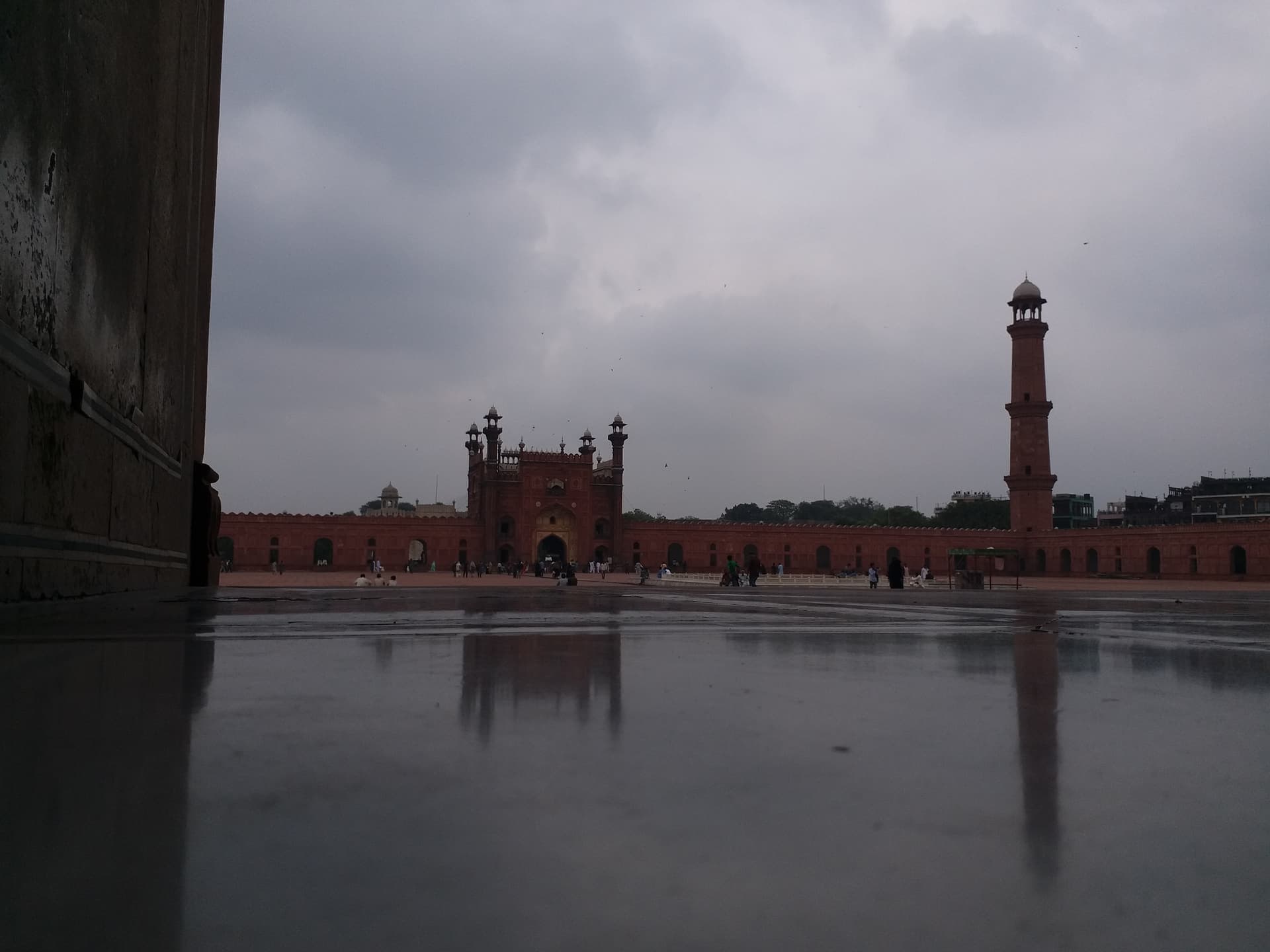
Aurangzeb's 1673 mosque — Lahore's red-sandstone masterpiece facing the Lahore Fort across Hazuri Bagh.
The Badshahi Mosque was the world's largest mosque for over 300 years. Its vast courtyard, marble inlay, and minarets define Lahore's skyline. Standing in Hazuri Bagh between fort and mosque, visitors experience the Mughal ceremonial heart of Punjab.
UNESCO fort complex — Sheesh Mahal, Alamgiri Gate, and layers from Ghaznavid to Sikh and British eras.
The Lahore Fort's origins reach the 11th century, but its zenith came under Akbar, Jahangir, and Shah Jahan. The Sheesh Mahal's mirror work, Naulakha Pavilion, and Picture Wall showcase peak Mughal artistry. Sikh and British additions tell Punjab's post-Mughal story.
Mughal charbagh gardens — terraced pools, marble pavilions, and UNESCO-listed landscape design.
Built by Shah Jahan in 1642, Shalimar Gardens exemplify Persian-inspired garden geometry adapted to Punjab's climate. Fountains once flowed without pumps using gradient engineering. Evening visits capture the romance of Mughal leisure culture.
City of saints — blue-tiled tombs of Bahauddin Zakariya, Shah Rukn-e-Alam, and Shams Tabrizi.
Multan's skyline is defined by shrine domes clad in turquoise faience. The city attracted Sufi orders for centuries, becoming a pilgrimage center on the Indus. Craft bazaars and fort ruins complement the spiritual architecture.
HistoricalIndus Valley
Harappa
Sahiwal
Namesake of the Harappan civilization — granaries, cemetery H, and urban planning parallel to Mohenjo-daro.
Harappa was among the first Indus sites excavated in the 1920s, giving the civilization its name. Though erosion damaged structures, surviving mounds and the site museum explain craft specialization, weights, and trade networks that linked Punjab to Mesopotamia.
HistoricalUNESCOSur dynasty
Rohtas Fort
Jhelum
UNESCO fortress built by Sher Shah Suri — massive gates and strategic Jhelum gorge location.
Rohtas was constructed in 1541 to suppress Gakhar tribes and secure the Sur dynasty's Punjab flank. Its 4 km walls, baolis, and Haveli Man Singh show military architecture at monumental scale — a contrast to Mughal elegance in Lahore.
Delhi Gate to Food Street — havelis, mosques, and living bazaar culture inside the old city.
The Walled City preserves Mughal-era urban fabric: Masjid Wazir Khan's tilework, Shahi Hammam, and narrow lanes of artisans. Restoration projects and food streets have revived tourism while communities continue centuries-old trades.
HistoricalPrincely
Noor Mahal
Bahawalpur
Italianate palace of Bahawalpur nawabs — chandeliers, Corinthian columns, and princely state grandeur.
Built in 1872 for Nawab Sadiq Muhammad Khan IV, Noor Mahal blends European neoclassical design with subcontinental court life. Bahawalpur's princely heritage offers a different Punjab narrative from Mughal Lahore.
Historical
Derawar Fort
Bahawalpur
Cholistan Desert fortress — 40 bastions visible for miles across the sand sea.
Derawar's current structure dates to the 18th century Nawabs of Bahawalpur, though the site is far older. It anchors Cholistan jeep safaris and the annual Jeep Rally, merging desert adventure with Rajput-era military architecture.
CulturalHindu
Katas Raj Temples
Chakwal
Hindu temple complex around a sacred pond — pilgrimage site with legend linking to the Mahabharata.
Katas Raj's Satghara temples surround a spring-fed pool revered in Hindu tradition. Restoration has preserved sandstone shrines that testify to Punjab's multi-faith past before Partition.
HistoricalMughal
Hiran Minar
Sheikhupura
Jahangir-era hunting pavilion near Sheikhupura — minaret memorial to a pet antelope.
Emperor Jahangir built Hiran Minar in 1606 in memory of his antelope Mansraj. The baradari sits in a large tank, reflecting Mughal hunting culture and architectural whimsy outside major cities.
Cultural
Wagah Border Ceremony
Lahore
Daily flag-lowering parade at the India-Pakistan border — patriotic spectacle minutes from Lahore.
The Wagah-Attari ceremony has evolved into choreographed military drill watched by thousands. While contemporary politics frame the event, its location on the Grand Trunk Road heritage corridor connects to Punjab's partition history.